



月末结账流程:分步指南
本文仅供参考,不旨在提供法律或财务建议,也不应被视为法律或财务建议。如果您对此主题有疑问,请咨询您自己的法律或会计顾问。
For many business owners and finance teams, the end of the month isn’t just about flipping a calendar page — it’s about reconciling, reviewing, and resetting the books. This is called the month end close, and it ensures financial records are complete, accurate, and ready for informed decision-making. Done well, the month end close process keeps you compliant, speeds up reporting, and provides a clear view of your company’s financial health.
Below, we’ll explain what the month end close process is, why it’s crucial, what it includes, and how to complete it step-by-step — plus how AP automation tools like Flex can help make it faster and more reliable.
What is the Month End Close?
The month end close is the process of reviewing, reconciling, and finalizing all accounting records for the month. This involves:
- Ensuring all transactions are recorded in the correct accounts
- Reconciling account balances
- Reviewing supporting documentation for accuracy
- Making necessary adjustments or accruals
- Generating preliminary financial statements
Once complete, the books are “closed” for that month, preventing further changes and providing a finalized record for financial analysis or audits.
Why is the Month End Close Important?
A thorough month end closing delivers multiple business benefits:
- Accuracy: Ensures financial statements reflect true business performance.
- Compliance: Helps meet tax and regulatory requirements.
- Efficiency: Prevents bottlenecks during quarterly or year-end closing.
- Decision-making: Provides timely, reliable financial data for strategic planning.
- Fraud prevention: Helps detect unusual activity or errors early.
Key Components of the Month End Closing Procedures
While exact steps vary by business size and industry, most month end close procedures include:
- Bank and credit card reconciliations
- Accounts payable (AP) review — ensure all vendor invoices are processed
- Accounts receivable (AR) review — verify customer payments are recorded
- Accruals and prepaid expenses adjustments
- Inventory counts and valuation updates
- Fixed asset depreciation
- Payroll reconciliation
- Intercompany transactions reconciliation (for multi-entity organizations)
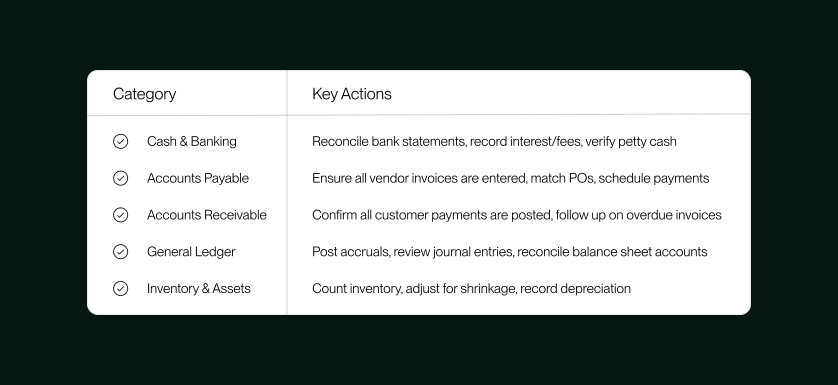
Month End Close Checklist
Here’s a sample checklist you can adapt to your business:
Step-by-Step Month End Close Process
Following a structured approach can make the month end close smoother and faster. The following steps walk you through exactly what you’ll need to do in order to complete your month end close process.
- Gather Financial Data
- Collect bank statements, credit card statements, vendor invoices, customer payments, payroll records, and expense reports.
- Reconcile Bank and Credit Accounts
- Compare your general ledger with statements to ensure all transactions are recorded and accurate.
- Process Accounts Payable and Receivable
- Verify that all invoices sent and received in the month are accounted for. Follow up on outstanding payments if necessary.
- Review Payroll and Benefits
- Ensure salaries, benefits, and tax withholdings are recorded correctly.
- Update Inventory and Fixed Assets
- Record changes in inventory and apply depreciation to assets.
- Post Adjusting Journal Entries
- Include accruals, deferrals, and corrections discovered during the review.
- Generate Financial Statements
- Prepare the income statement, balance sheet, and cash flow statement for internal review.
- Finalize and Lock the Period
- Close the accounting period to prevent changes, ensuring data integrity.
Common Month End Closing Challenges
Even seasoned finance teams can hit roadblocks when closing out the month. Common issues include:
- Missing or late documentation
- Incomplete transaction entries
- Manual data entry errors
- Disconnected systems requiring duplicate work
- Delays in approvals for invoices or expense reports
How AP Automation Speeds Up Month End Close
Manual processes can make month end closing a stressful scramble. With Flex’s AP automation tools, you can:
- Capture invoices automatically with OCR and digital workflows
- Match POs and receipts instantly to reduce manual review
- Automate approval routing to avoid delays
- Schedule payments in advance to ensure timely processing
- Integrate directly with your accounting system for real-time data updates
By automating these repetitive tasks, your finance team can shift focus from chasing paperwork to analyzing results.
Final Thoughts
The month end close process is a cornerstone of strong financial management. When done right, it ensures accuracy, compliance, and confidence in decision-making. With a clear month end close checklist and the right tools — like Flex’s AP automation platform — you can streamline your workflows, close faster, and keep your business financially healthy.







.png)


.png)